

How to Sketch Liverpool's Waterfront: Urban Sketching for Beginners
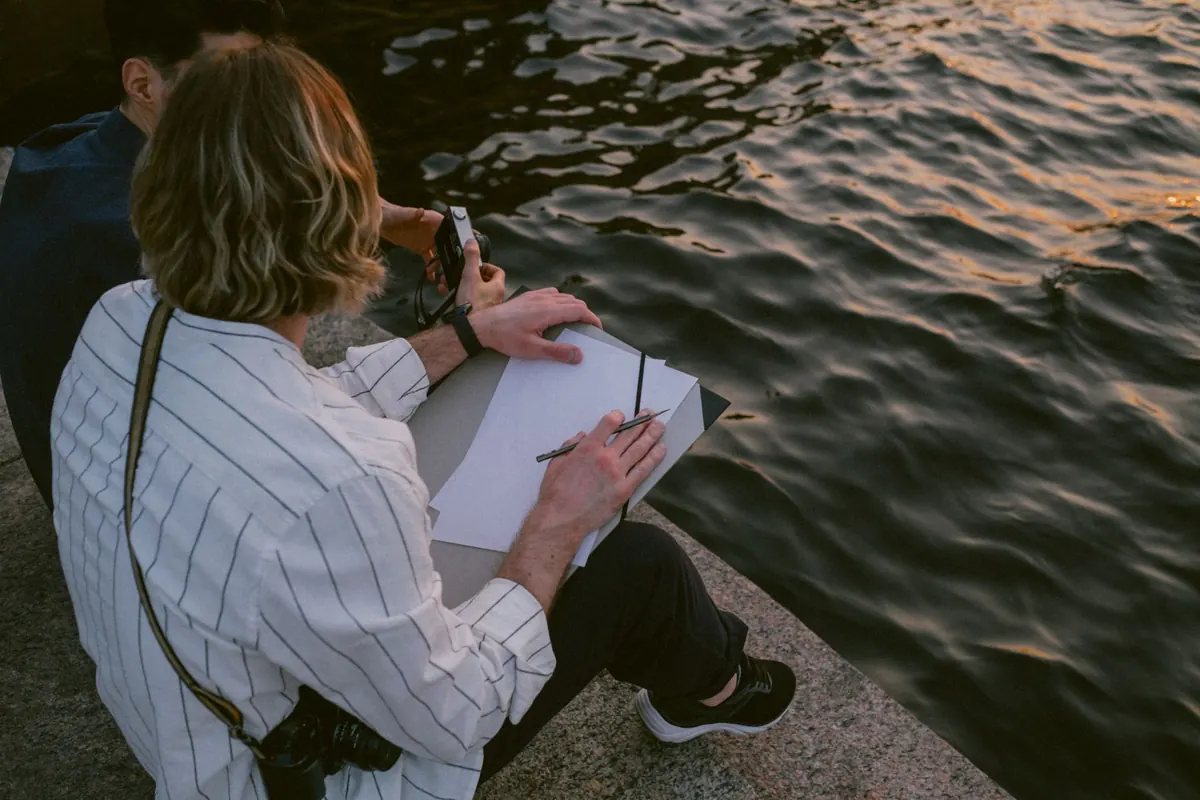
The Mersey makes a hard subject easy to fall for. Stand at the Pier Head, turn a quarter circle, and you have the Three Graces, the ferry terminal, the Museum of Liverpool and a working river with tugs and tankers on it. That is a lot of lines to get wrong. The trick is not to draw Liverpool's waterfront. Draw one piece of it, from a spot you can come back to.
This is for anyone who can hold a pencil and wants to spend a Saturday morning using it properly. No drawing class required, no expensive kit, and no need to wait for good weather.
Start smaller than you think
The Three Graces drawn in one sitting is a three-building, several-hundred-window exercise in disappointment. Pick one thing instead. The clock face and crown of the Royal Liver Building seen from the south end of the quay. The dome of the Port of Liverpool Building. The ferry terminal canopy, with the Snowdrop's rigging behind it. Or skip architecture entirely and draw the cast-iron bollards along the Albert Dock, a gull on a mooring ring, or the tangle of ropes and railings at the landing stage.
Small, finished drawings teach far more than one abandoned panorama. A good exercise: choose a single object and draw it three times from three positions, ten minutes each. By the third, your hand stops arguing with your eye.
Frame it before you draw it
Draw three thumbnails first, each the size of a matchbox, thirty seconds apiece. This is where you decide things, and it is much cheaper to change your mind here than on a full page.
- Put the horizon a third up or a third down, never dead centre.
- Use a leading line: the dock edge, the row of bollards, the arcade columns running away from you.
- Give the foreground something close and cheap — a coffee cup, a folded coat, the back of a stranger's head.
- Push the Liver Building off to one side and let the river hold the empty space. Symmetry is boring.
- Let something leave the frame. The eye finishes it without being asked.
A tall subject such as the clock tower wants a portrait-format page. The Albert Dock arcade wants landscape. Match the shape of the paper to the shape of the thing before you commit.
Perspective without a ruler
Your eye level is the horizon line, roughly 1.5 metres up when standing, lower when perched on a dock bench. Everything at that height meets there. Views along a dock channel, such as looking down Salthouse Dock towards the river, are one-point: lines converge on a single spot. Corner-on views of the Three Graces are two-point, with two vanishing points, usually far off the page.
- Hold your pencil at arm's length, close one eye, and line the pencil up with a roofline's slope.
- Keep your arm locked and turn your wrist to transfer that angle to the page. Check every slope this way.
- If a vanishing point falls off the paper, tape a spare sheet to the side of your book and draw it there, then run faint guide lines back across.
- Treat round towers as cylinders and wrap the lines of windows and stonework around them.
- When a line goes wrong, leave it. Drawing a corrected line on top of a bad one makes a mess; a stray line reads as character.
Kit that survives a Mersey morning
The waterfront is windy, salty and prone to showers arriving sideways. Anything water-soluble will run. What works:
- A hardback sketchbook, A5 or A4, 140gsm paper or heavier. Spiral-bound books flap themselves to death in the wind.
- Waterproof fineliners in 0.1, 0.3 and 0.5. Sakura Pigma Micron and Uni Pin are reliable. Test yours on damp paper before you trust them.
- A 2B or 3B pencil and a kneadable eraser. Pencil goes under the ink, not over it.
- A small watercolour set — twelve pans is plenty — and a water brush instead of a loose pot, which the wind will find.
- Two bulldog clips and a lightweight board. The clips stop the page lifting; the board gives you something rigid.
- A folding stool or foam mat. Dockside stone pulls the heat out of you fast.
- Waterproof jacket with a hood, fingerless gloves, brimmed hat. Cold hands end sketches early.
- A plastic bag for wet paper and a cloth for drying the page.
A phone snap is useful if the weather turns mid-sketch, but use it only to finish lines you have already started. Drawing from a photograph teaches you nothing about the place.
Light, weather and the Liverpool grey
Flat overcast is a gift: even light, no shadows to chase. It also turns everything into grey mush if you copy the tones honestly. So cheat. Make the Liver Building's silhouette darker than it really is, leave the sky as bare paper, and put your darkest darks under the arcade.
The Pier Head faces the river roughly west, so late afternoon and early evening light hits the fronts of the Three Graces and warms the sandstone. Morning sketches tend to be backlit, which is ideal for pure silhouettes. The Mersey itself is rarely blue — grey-green, silver, sometimes brown. Use grey, ochre and a little raw umber rather than a hopeful blue.
When it rains, shelter. The Albert Dock arcades, the Museum of Liverpool, the ferry terminal and any dock-facing café window work well. Sketching through glass with a brew beside you is a legitimate Liverpool technique.
Where to sit, and how to behave
The Pier Head has benches and the widest view. The Albert Dock gives you arcades for shelter and quay edges for reflections. The steps of the Museum of Liverpool are good for the whole sweep. Cross the water to Seacombe or Woodside and you get the entire skyline in one one-point composition, which is the easiest way to make sense of it all.
Keep the walkway clear, never park a stool or tripod across a path, and ask before drawing anyone close up. Leave children alone. Most people are pleased to be included, and a quick "mind if I sketch you?" costs nothing.
A first Saturday, hour by hour
9am. Coffee, then a slow walk along the quay. Choose one subject and do three thumbnails.
9.30. Block in the big shapes in pencil: the rectangle of the building, the band of river, the line of the quay. Ten minutes, no detail.
9.50. Ink the lines you are sure about, working left to right and top to bottom so your hand does not smudge what you just drew.
10.10. Add tone with a grey wash. Leave white paper for sky and highlights.
10.30. Stop, date the page, note the place and the weather. Then walk a few steps to the left and draw the same subject again.
Two finished sketches is a good morning. Come back to the same spot next month in different weather, and fill a book over a year. That habit will teach you more about drawing Liverpool than any new set of pens.
Photo: Ron Lach / Pexels